Third Space Wellness in Kuta Lombok
Discover third space wellness in Kuta Lombok. Learn how a calm, design-driven spa and café supports rest, recovery, and ritual.

Kuta Lombok has a way of making the first hour after arrival feel both easy and unsettled. The air is warm, the light is soft, your bag still has the shape of the journey, and your day can go in several directions at once. What many travellers want in that moment is not just a spa, a café, or a lounge, but a room that sits between them, a place where the body can settle and the mind doesn't have to choose between being social and being still.
That in-between room is what third space wellness describes. It brings together recovery, hospitality, and a low-pressure sense of belonging, so the day feels less like a checklist and more like a rhythm. If you're in Kuta Lombok, or planning to be, the idea becomes very practical very quickly.
Table of Contents
- A calm room between home and holiday
- What a third place really is
- Why wellness is a natural third place
- How a wellness third space is designed
- An afternoon at a wellness third space
- Choosing or creating your own third space
- An unhurried close
A calm room between home and holiday
You land, your feet meet island heat, and the day opens up faster than your body can catch up. The beach is tempting, the villa is waiting, and a treatment sounds good, but none of those alone quite answer the deeper need for an hour that isn't performative or rushed. You want a place where you can arrive slightly tired, sit down without ceremony, and feel the pace of the day drop.
That's the heart of this subject. A third space is the room between private life and the places where you have to perform, and in wellness, that middle ground matters because rest and social warmth often work better together than apart. In Kuta Lombok, that idea fits the traveller's day especially well, because the island invites movement, sun, and recovery in the same breath.
From sociology to a beach town rhythm
The phrase comes from social theory, but the lived version is easy to recognise. It's the difference between going back to your room alone and settling into a calm café where someone remembers what you like to drink, even if you don't feel like talking much. One path is private. The other is gently communal.
Practical rule: if a place lets you stay without pressure, return without awkwardness, and interact without a script, it's acting like a third space.
For a traveller, that matters because the day after a flight is rarely just about sleep. It's about easing into island time, choosing a pace, and finding a place that doesn't ask you to switch fully into “activity” mode before you're ready. That's why wellness venues can feel so natural here, especially when they're built for lingering, not just turnover.
If you've ever wondered why a good café, a good treatment room, and a good lounge can all feel restorative in different ways, the answer is simple. They each give you a different kind of permission. The rest of the article turns that feeling into a clearer way of choosing where to go in Kuta Lombok.
What a third place really is
Ray Oldenburg's idea is simple once you strip away the jargon. Home is the first place, work is the second place, and the third place is the informal setting where people gather voluntarily and repeatedly. Oldenburg's examples included cafés, taverns, libraries, hair salons, main streets, and community spaces, places shaped less by obligation than by conversation, familiarity, and ease. UNESCO's account of the idea also notes the role of cafés and coffeehouses in supporting warmth, conviviality, free speech, and informal association, which is a useful reminder that social life has always needed somewhere in-between the formal places.
“Third places are informal settings outside the home and workplace where people gather voluntarily and repeatedly.”
That definition matters because it explains why some spaces feel naturally alive. A hotel lobby can be beautiful and still feel anonymous. A familiar café can feel welcoming before you've even sat down, because the room already knows how to hold people without demanding anything from them.
Why the middle matters
A third place lowers the cost of social contact. You don't need an invitation, a full agenda, or a big emotional commitment. You can be quiet, brief, talkative, or somewhere between those states. That's part of why neighbourhoods feel more inhabited when they have places people return to regularly.
For a traveller in Kuta Lombok, the missing piece is often exactly this middle setting. You may have the villa, the beach, and the excursion, but not the room where you can exist for a while among other people. Wellness venues designed for lingering can fill that gap, because they give you something a clinic usually doesn't and a hotel usually won't: a calm, repeatable social rhythm.
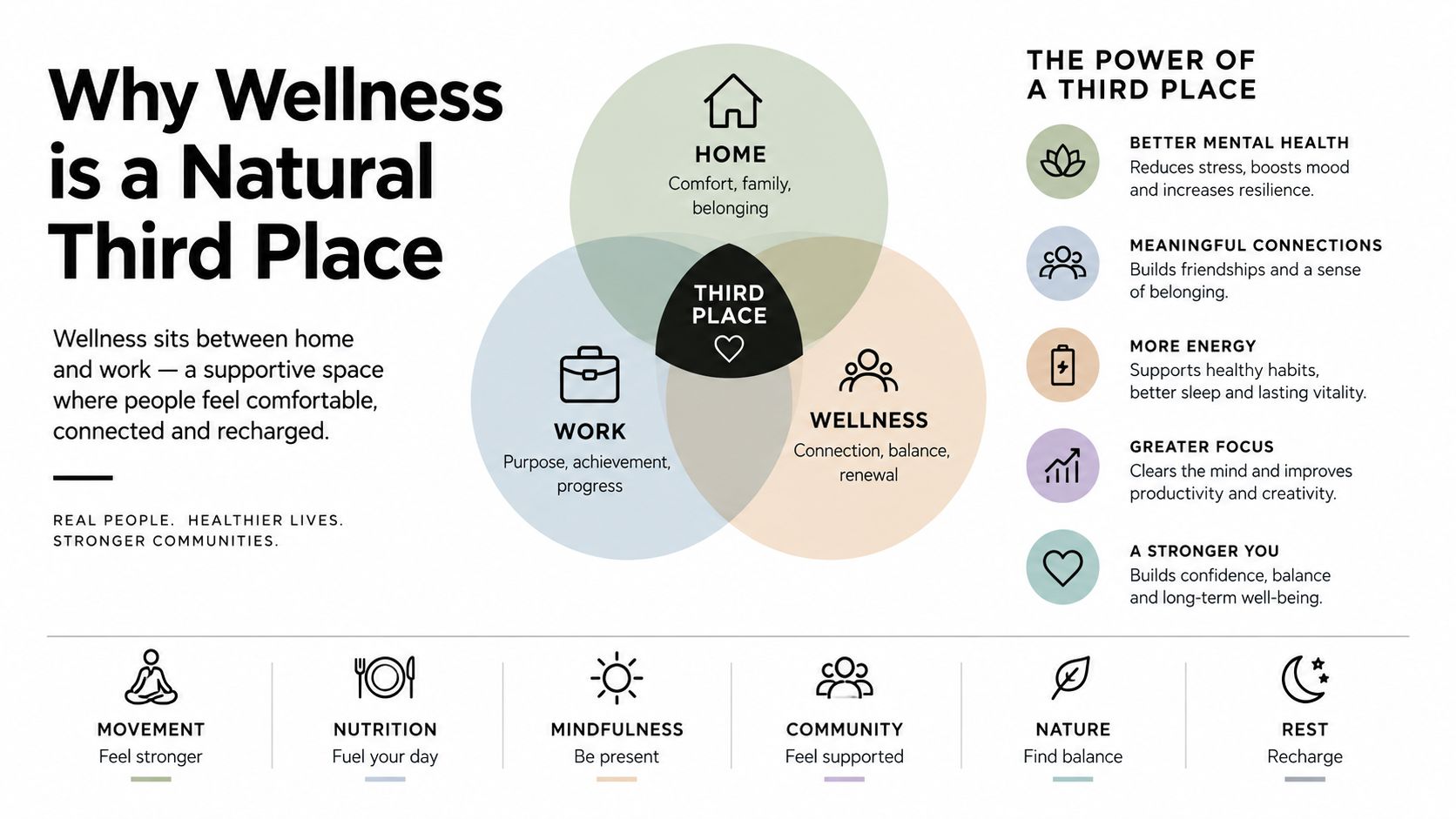
That's why the idea translates so cleanly into wellness. When a place is built for conversation, familiarity, and ease, recovery becomes more than a service. It becomes a way of inhabiting the day.
Why wellness is a natural third place
A traveller landing in Kuta Lombok often feels the day split in two. There is the effort of arrival, the heat, the bags, the unknowns. Then there is the need for a room that lets the body settle without asking for the full formality of a hotel or the intensity of a clinic. Wellness fits that middle ground because it gives recovery a social setting.
The scale of wellness helps explain why this feels so natural. The global wellness economy reached approximately $6.8 trillion in 2024, after growing 7.9% from 2023 to 2024 and doubling in nominal size since 2013, according to the Global Wellness Institute (Global Wellness Institute statistics and facts). Wellness also accounted for 6.12% of global GDP in 2024, which places it far beyond a narrow spa category.
That reach matters in practice. Once personal care, bodywork, food and beverage, and restorative rooms sit together, the visit starts to resemble ordinary life rather than a single appointment to finish. Wellness tourism also represented 13.2% of worldwide wellness spending in 2024, and towns such as Kuta Lombok feel that demand in the places travellers choose to rest, eat, and stay a little longer.
A tradition older than the modern spa
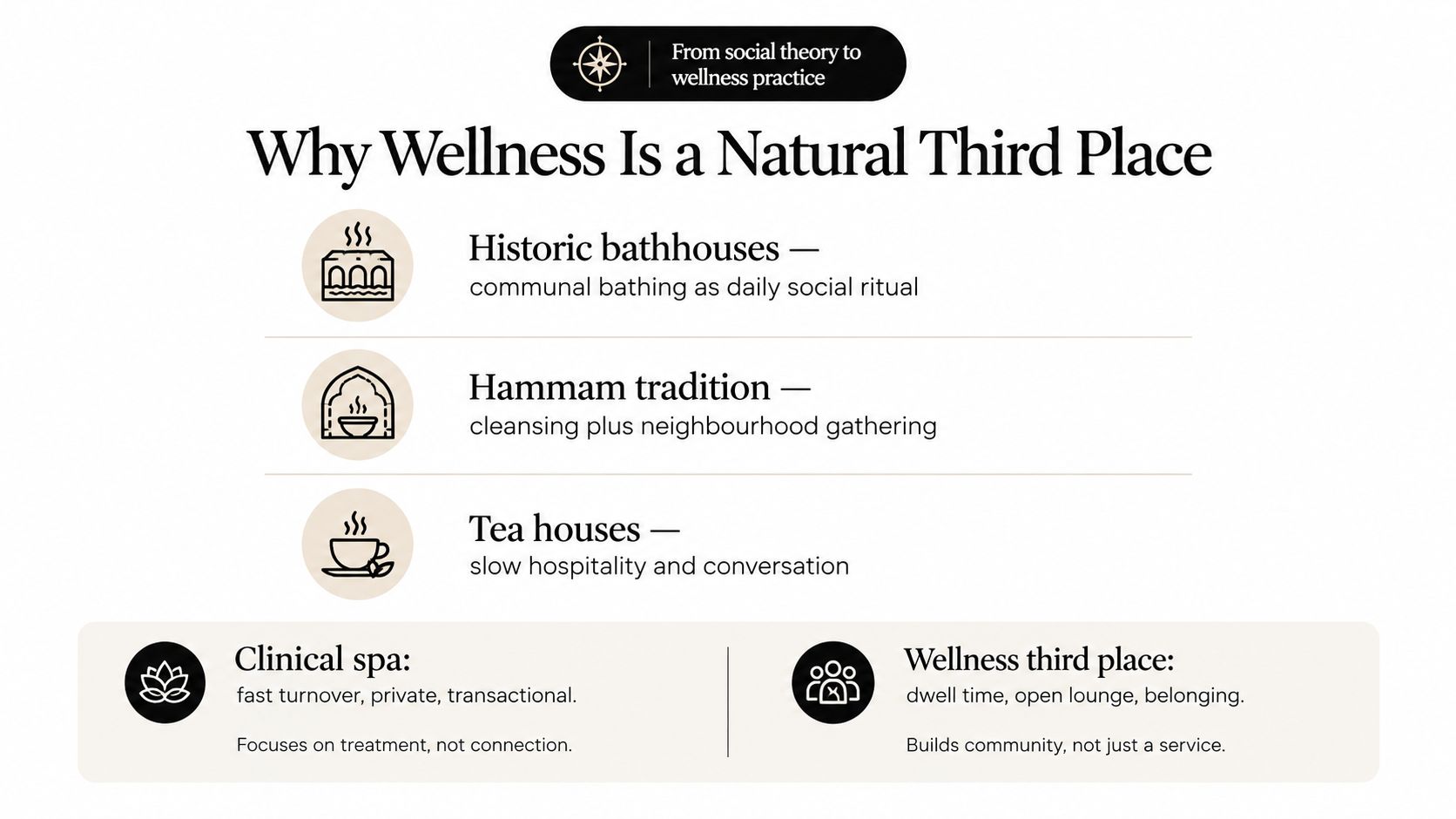
Wellness has older roots than the modern spa. Bathhouses, hammams, and tea houses have long joined cleanliness, conversation, and ritual in one setting. The modern wellness venue follows that same pattern when it offers care with social warmth.
The practical result is easy to feel. A guest may come for a facial or massage, stay for a drink, and leave having also spent time in a room that supports rest or gentle conversation. In a place like Lombok, where days often move between beaches, dinners, and active outings, that in-between room gives the day a steadier rhythm.
How a wellness third space is designed
A third space doesn't happen by accident. The room has to invite lingering, but not force it. It has to be calm, but not cold. It also has to make social contact feel optional and easy, which is harder to do than it sounds.
A 2025 scoping review of 32 studies found that access to community facilities, local businesses, and parks was associated with greater social interaction in more than two-thirds of the reviewed studies, and accessible local businesses were linked to larger or more developed social networks (European Journal of Ageing study). That finding fits the hospitality side of wellness well. People are more likely to return, stay, and connect when the space is open, comfortable, and easy to use.
The cues guests actually feel
The most useful design cues are the ones you notice without consciously naming them:
- Light: soft, layered lighting makes a room feel restful rather than clinical.
- Sound: quiet is good, but complete silence can feel awkward, so a controlled soundscape matters.
- Scent: clean air and a gentle scent help signal calm without overwhelming the senses.
- Seating: visible but not intrusive seating invites pause.
- Drinks: water, tea, coffee, or another simple refreshment turns waiting into staying.
- Staff tone: warm, brief, and unhurried communication makes people feel welcome without pressure.
Design rule: if every part of the room says “finish quickly”, it's not a third place. If the space quietly says “you can stay”, it's getting closer.
The logic behind this is cumulative familiarity. Repeated small encounters can become easier, more relaxed, and more recognisable over time. That's why transparent hours, accessible booking, and space for both tourists and locals matter so much. They help the venue become a regular part of life rather than a one-off stop.
In Kuta Lombok, those design choices are especially meaningful because the day often moves between motion and rest. A place that understands both can hold the traveller more gently than a purely transactional treatment room ever could.
An afternoon at a wellness third space
The day starts with a tired arrival and a simple decision. After the flight, the sun feels bright enough to notice, and the idea of heading straight back out toward Kuta Beach, Tanjung Aan, or Selong Belanak is appealing but a little too sharp. So the guest chooses a calmer reset and heads to GLAZE, House of Wellness, Jl. Raya Kuta No. 20, Kuta, Central Lombok, NTB 83573.
The first part of the visit is physical. Maybe it's a Balinese massage, a deep tissue session, or a hydrating facial after travel and sun. The point isn't drama. It's comfort, pace, and that subtle feeling of the body loosening its grip on the journey.
The part that happens after the treatment
Then comes the transition that makes the place feel like more than a spa. The guest steps into the café side, orders an espresso or ceremonial matcha, and stays a little longer than planned. There's fresh coconut or cold-pressed juice if that feels more fitting, and the room supports the pause instead of pushing the exit.
The third space idea becomes visible here. The treatment matters, but so does the time between treatment and departure. A guest can sit, watch the light shift, and decide whether the afternoon should stay quiet or turn into a dinner plan later on. The room leaves that choice open.
The same logic works for smaller rituals too. A glazed manicure before a wedding dinner, a pedicure before a beach evening, or a quiet recovery stop after padel or a surf morning all fit naturally into the rhythm. The place becomes useful because it can hold more than one mood at once.
A good wellness third space doesn't rush you from service to exit. It gives the body time to catch up with the day.
That feeling is what travellers remember. Not just the treatment itself, but the pause after it, when the room still feels generous and the day still feels unforced. In a destination like Kuta Lombok, that kind of afternoon is often exactly what people are looking for, even if they don't have a name for it yet.
Choosing or creating your own third space
When you're choosing a place in Lombok, start with the simplest question. Can you arrive for one service and stay comfortably for another 20 or 30 minutes without feeling out of place? If the answer is yes, the venue probably understands third space wellness better than a place built only for turnover.
A few signs help quickly:
- Dwell-friendly seating that feels intended for lingering, not only waiting.
- Real refreshment service so a drink isn't an afterthought.
- Clear separation between quiet treatment rooms and more conversational areas.
- Transparent booking and opening patterns so the visit feels easy to plan.
- Staff who invite choice rather than steering everyone toward the same pace.
For travellers, the best pairings are often the ones that match the day's rhythm. A deep tissue or aromatherapy massage after a surf morning feels different from a hydrating facial before an afternoon in Mandalika, and both can work if the rest of the visit stays calm. The same goes for a slow matcha after beach time or a coffee before dinner plans.
Travel fatigue adds another reason to keep the pace gentle. Jet lag symptoms generally last about one day for each time zone crossed when travelling eastward and about half a day per time zone when travelling westward, and research on athlete recovery notes that even flights as short as 6.5 hours can reduce sleep quality and increase fatigue (travel-fatigue research). That means massage and quiet time work best as companions to sleep, hydration, daylight, and movement, not as replacements for them. Research on travel adaptation also recommends using light deliberately, for example by maximising morning light after eastward travel and evening light after westward travel (light exposure review).
If you'd like a calm reset in Kuta Lombok, book a Balinese massage, deep tissue session, hydrating facial, or glazed manicure at GLAZE, House of Wellness, Jl. Raya Kuta No. 20, Kuta, Central Lombok, NTB 83573. You can reserve via WhatsApp and make the afternoon easier to shape around the rest of your trip.
At home, the same idea is simple to recreate in miniature. Keep one chair, one drink, one quiet corner, and one habit of returning to it. A third space doesn't need to be elaborate to feel restorative.
An unhurried close
The best version of third space wellness doesn't try to invent a new human need. It gives shape to an old one, the need for rooms where care, conversation, and recovery can sit comfortably together. That's why the idea feels so natural in Kuta Lombok, where travellers arrive tired, local routines keep moving, and the best pause is often the one that feels unforced.
The practical lesson is easy to remember. Choose places that welcome lingering, not just visits. Pair bodywork with café time. Let the first days of a Lombok trip include daylight, hydration, and rest, so the island's pace can meet yours instead of racing ahead of it.
For travellers who want that calm, premium rhythm in one place, GLAZE - House of Wellness brings together Balinese massage, deep tissue, aromatherapy, reflexology, hydrating and anti-aging facials, manicure and pedicure care, plus an on-site coffee and matcha bar, all at GLAZE, House of Wellness, Jl. Raya Kuta No. 20, Kuta, Central Lombok, NTB 83573. It's an easy fit for a day that needs both recovery and a place to stay a little longer.
If you're planning time in Kuta Lombok, book a treatment at GLAZE - House of Wellness and shape your visit around a calmer kind of day. Choose a massage, facial, or nail service, then let the café, the pace, and the room do the rest.
- third space wellness
- Kuta Lombok spa
- calm wellness
- spa and café
- wellness rituals